A Valley Without Wind 2 puts a group of mages inside a campaign that keeps changing scale. One moment you and your friends are moving through a side-scrolling stage, jumping between ledges and throwing spells at creatures; the next, the view pulls back to a turn-based world map where the resistance needs food, recruits, and safe ground. Most internet sessions are recommended for two to eight players, while LAN sessions can include larger groups. Its appeal comes from pairing shared spell fights with a larger campaign about keeping an uprising alive.
A platforming stage changes the map
You play a mage who has infiltrated the circle around Demonaica, an overlord who has spread his power across a storm-wracked land. The mage carries an Oblivion Crystal that grants immortality, the same power that protects the enemy leader. The threat is wider than the hero, though: Demonaica and his forces hunt resistance members on the map while five henchmen pursue you through the action stages. Friends who join the journey appear as additional mages, each bringing a separate character into the same side-scrolling action.
The campaign alternates between platforming and strategic turns. On the map, a region is represented by a tile: forests, settlements, ruins, frozen land, and areas still hidden behind dark wind. Entering a region takes you into a procedurally assembled action stage. You move through its passages, fight or avoid creatures, open chests, and search for the windstorm generator that blocks progress. Destroying it clears the storm from nearby tiles and advances the resistance’s turn. A stage therefore has a concrete endpoint, but what becomes reachable afterward depends on the map around it.
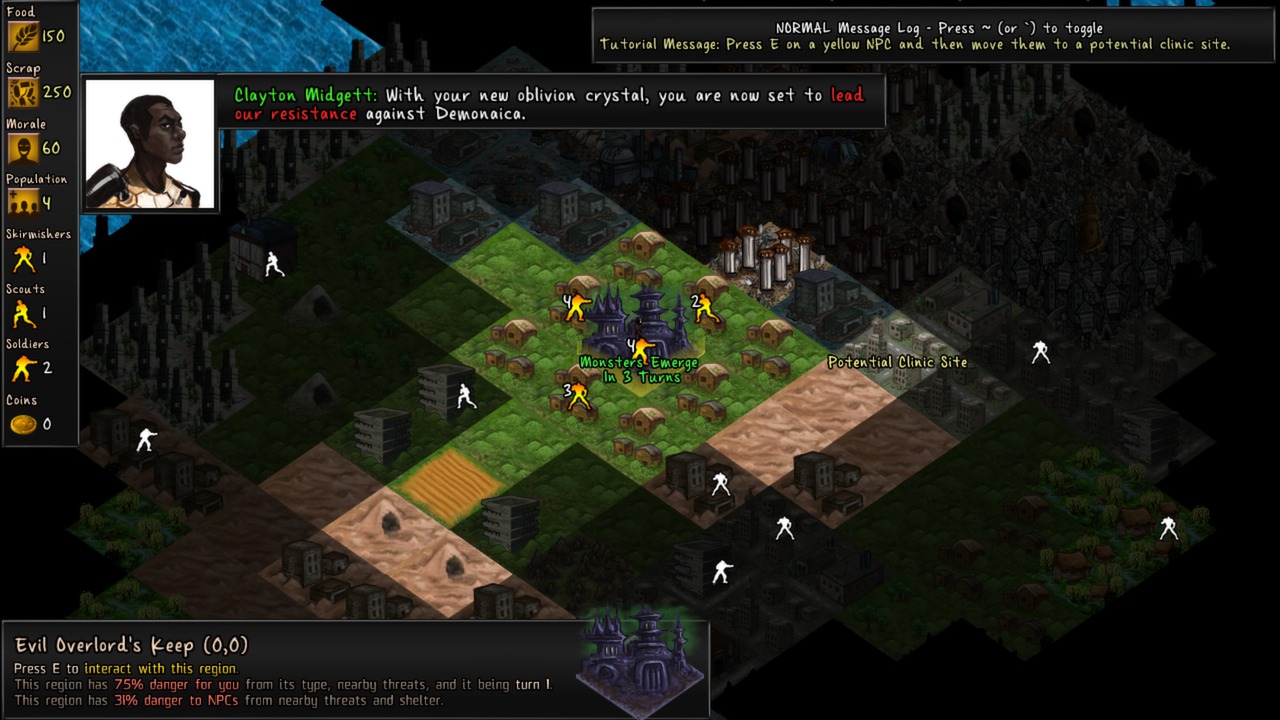
The world map is more than a level picker. Your resistance has a population to feed and a network of occupied tiles to maintain. Troops can fight, collect supplies, recruit new people, farm, build, or use special abilities. Scrap pays for construction, food keeps followers going, and the enemy can send monsters toward your units or damage parts of the map. A turn resolves those pressures together: the game reports the resources gained or lost and what happened to units before you return to the action side.
You and your friends are helping one uprising push through the same territory, not running separate kingdoms against each other. The map layer gives context to the co-op run by changing which regions are open and how the resistance is faring, while the most direct shared play happens when several mages enter a platforming stage together. That combination makes the game unusual for a group: the action is immediate and visible, but the wider campaign moves in measured turns rather than asking everyone to control a real-time battle at once.
Each mage brings a different spell set
The mage classes shape how each person moves and attacks. The full game advertises fifty classes across five tiers, with four abilities assigned to a class: a primary spell, a secondary spell, a special attack, and an ammunition-based ability. The spells have weight and can collide with one another, so combat is not only a matter of firing in the right direction. A projectile may block another, a burst may fill a narrow passage, and a class’s movement can affect which ledges or gaps are practical to cross.
That class system gives co-op groups different spell combinations without turning the characters into a fixed healer, tank, or damage chart. Each player has an individual mage and spell loadout; the characters can be changed as the campaign progresses. A class may favor quick shots, a wider burst, or a movement effect, and the action stage lets those choices meet on screen. The roster is large enough to make replaying a campaign with a different mage feel distinct. Classes unlock across five tiers, so a new run begins with a narrower set of choices and gains options as the resistance advances.
Your four active spells are always close at hand, and they make a class legible at a glance: one basic attack, another spell, a special, and the ammo-powered move. Some effects send a narrow bolt through a corridor; others create a short-range burst or interact with the terrain. Because projectiles have mass and can block each other, a packed screen can become an obstacle course as much as a firing line. The game leans into unusual spell pairings instead of asking each mage to fill a standard party job.
Equipment and character growth add another layer between visits to the map. Chests can contain gear with a benefit paired to a drawback, such as stronger attacks traded for slower movement. Level-up sites award feats or perks that alter health, jumps, or spell strength, while explored facilities can add movement abilities. The world and its loot are procedurally generated, so a familiar campaign structure can lead to a different set of regions, equipment choices, and class options on another run.
The two halves affect one another without becoming identical systems. Stronger spells and movement abilities help your mage handle tougher stages; capturing map facilities can open additional improvements, and clearing a windstorm generator exposes more of the strategic world. Meanwhile, your troops still need resources while the mage is away. A platforming section may be only a few minutes long, but the turn that follows can cost food, put a unit in danger, or bring Demonaica closer to your forces.
That rhythm means the group does not spend the whole session inside one uninterrupted gauntlet. The map pauses the action, shows what the resistance gained, and changes which tiles are available. Some places are useful because they provide food or scrap; others hold a building, a level-up site, or a route toward a henchman. The strategic side is still a turn-based campaign management layer, not a real-time tactics game running alongside the platforming.
A long campaign with pressure from both sides
Demonaica is not a distant final boss waiting at the end of a string of levels. His forces press into the map as turns pass, and the overlord himself can move among the tiles and threaten your units. The resistance grows by recruiting survivors and assigning them to jobs, but a force that has too few supplies or loses too many members can fall apart. Keeping the campaign moving means balancing the mage’s exploration with the condition of the people who remain on the strategic map.
The action levels also change the kind of pressure you face. Windstorms obscure the wider map, while caves, ruins, forests, and other environments give stages different shapes and hazards. Enemies range from smaller creatures that crowd a passage to heavier foes with defenses. The spell system includes attacks with different shapes and behaviors, and the stage can reward movement as much as damage: a jump may bypass a threat, while a cramped corridor can make a wide spell hard to place. It is a colorful, strange fantasy world, but its battles can feel busy and its art mixes painted scenery with small animated characters and effects.
The art moves between hand-painted backgrounds and compact animated figures, with bright spell effects cutting into shadowed caves and stormy outdoor scenes. Its soundtrack adds a sweeping, sometimes mournful tone to the resistance story. The atmosphere is more fantastical adventure than horror: the danger comes from crowded platforms, pursuing monsters, and watching the map deteriorate while you are away. Biomes and procedural layouts alter the scenery, though the basic task of crossing a stage and finding its generator remains the campaign’s recurring beat.
Difficulty settings let you tune the action and strategy portions separately. That distinction matters because the campaign asks two different questions: can your mage survive the next region, and can the resistance hold together over the next turns? Lowering one side does not automatically remove the challenge from the other. For a group, the split lets friends spend most of their attention on the spell action while keeping the strategic campaign legible, or make both sides more demanding over a longer shared run.
There is a complete beginning-to-end campaign rather than an endless sandbox. The world is generated for a run, the map opens as storms are cleared, and the resistance eventually confronts Demonaica and his henchmen. A run can last many sessions because the map management and action stages both contribute to progress. The procedural tiles and varied class loadouts provide replay differences, but the central loop stays recognizable: advance into a region, clear the platforming stage, resolve the map turn, and decide which part of the uprising needs attention next.
Getting a group connected
Online co-op and LAN co-op are available. Most internet sessions are recommended for two to eight players; a LAN can support larger groups, but there is no dependable hard maximum to plan around. Treat eight as the practical internet recommendation rather than a guaranteed cap. Each friend joins as a separate mage during the platforming sections.
Cross-platform multiplayer is supported, but the exact Windows, Linux, and macOS combinations are not specified. The macOS build is incompatible with Catalina and newer, while Windows and Linux builds are available. Controller support is partial, and keyboard controls are available too, so the game is not controller-only.
For a group that likes both jumping into a shared action stage and pausing to see how a turn changes the campaign, A Valley Without Wind 2 offers a co-op structure few platformers use. The map provides a common objective beyond clearing the next room, while classes, spells, procedural areas, and loot make each mage’s moment-to-moment play personal. It is less straightforward than a drop-in arena game: the session is built around a campaign map, a server connection, and a mix of action and strategy. If your friends want an unusual fantasy campaign that puts both systems in one run, its cooperative mages have a lot of ground to cross.