Legend of Dungeon puts you and up to three friends in one randomly assembled dungeon, then asks you to reach its deepest floor, take the treasure, and make it back out. It plays as a real-time brawler with roguelike consequences: you move, jump, attack, search rooms, and collect whatever weapons, hats, potions, or magic happen to turn up. The run is built for local co-op on one computer, with each player controlling a character in the same expedition. If one person is defeated while others remain, that player becomes a ghost instead of leaving the session for good. Your group can keep pushing into the dungeon, but a full collapse can still end the attempt.
The game has no built-in online co-op lobby or network campaign. Steam Remote Play Together can stream the local session to friends over the internet, but the host’s computer still runs the game; that is a streaming route for local multiplayer rather than native online matchmaking. For the most straightforward setup, your group needs to share one computer and screen. The game supports multiple controllers, and each player can configure an input method. There is also a shared-screen PvP option if your group wants a versus mode, though the co-op run is the focus here.
A route down, then a long climb back
Your destination is the treasure on the 26th floor. Getting there is only half of the objective: you then have to retrace the route and return to the tavern above. Each floor is divided into rooms with doors, stairs, enemies, hazards, and things to collect. The map layout changes between runs, so a familiar-looking corridor may lead somewhere different next time. In some rooms you will see a staircase or exit quickly; others make you check side paths, look for a hidden opening, or decide whether the light ahead is worth the trouble.
Exploration is shared in a practical sense. You and your friends move through the same room and face the same enemies, rather than splitting into separate lanes or choosing separate missions. Each person has an individual character display and inventory, so a useful weapon or hat changes that player’s loadout rather than becoming a team-wide upgrade. The common goal still gives every pickup a group context: more strength can help one adventurer survive a dangerous room, and a light source can make the next stretch visible to the people nearby.
The dungeon does not behave like a neat sequence of combat arenas. Some chambers are dark enough that a lantern, glowing hat, spell, or weapon can shape what you can see. A narrow passage can hide a drop into lava, a pressure plate may shift a bridge or trigger another danger, and an apparently empty wall may conceal a door. Traps and enemy groups can appear close together, so movement and awareness matter as much as swinging your weapon. The game also uses glowing doorways to help you recognize paths you have visited, which gives an irregular maze just enough visual memory to navigate without turning it into a marked map.
The outward trip gives your party a clear through-line, but the return can feel different from the descent. You have already spent health, used consumables, picked up weapons, and learned which nearby routes lead toward the staircases. Each new floor introduces more threats and different room arrangements. The treasure is therefore not a simple boss reward that ends the moment you reach the bottom: you still need to get back to the tavern with enough of your group alive to make the climb.
Brawling, leveling, and strange equipment
Combat uses a small set of direct actions. Your character can move, jump, attack, and charge an attack for extra force. Early enemies may go down with a few swings, while deeper floors bring larger creatures and foes that attack from a distance or fill a room with other threats. You collect experience orbs from defeated monsters to raise your character’s stats, including health and attack power. The basic fighting remains simple, but the situation changes with the enemies, items, room shape, and light around you.
Weapons and equipment make individual characters feel less identical as a run develops. A sword gives you a straightforward close-range hit; a long weapon, hammer, gun, magic book, or other find can shift how you approach a fight. Hats are more than a joke wardrobe: some provide defense or stat changes, while others bring an unusual ability, movement effect, or source of light. The game includes unlockable classes and tameable pets as additional things to discover, though the immediate variety comes from whatever gear and consumables appear during the expedition.
Items are deliberately unpredictable. Apples restore health, while potions can produce different effects from one run to the next. Magic and equipment can summon creatures, launch projectiles, illuminate rooms, or alter a character’s stats. Random properties mean that a bright-looking bottle is not a reliable plan on its own, and a new piece of gear may trade one advantage for another. That uncertainty can make each run feel like a new set of small decisions, especially when a strong weapon appears early or a useful light source does not.
The game also places merchants and other characters in random encounters. A shop can let you spend collected treasure on supplies, and some characters offer a gamble or another unusual interaction. These stops break up the rooms of fighting and searching without turning the run into a town-building loop. Gold and treasure contribute to score, while weapon and hat finds affect your immediate survival. The expedition keeps its focus on moving through the dungeon, discovering the next strange item, and seeing how much farther you can get.
When a player falls
Death has a special shape in co-op. Once a player is defeated, their character returns as a ghost. Enemies defeated by surviving friends can leave spirit orbs, and the ghost can collect enough of them to come back to life. That gives a fallen player something to do while the rest of the team continues fighting, and it makes keeping at least one adventurer standing especially important. You are not just waiting for a revive animation or hoping someone finds a checkpoint; your ghost can move through the ongoing action and gather what is needed to return.
The mechanic softens permadeath for a group, but it does not erase the danger. A defeated character loses the gear carried at that point, and recovering requires the active players to keep defeating enemies while the ghost gathers orbs. If everyone goes down together, nobody remains to create that route back. Your party’s equipment and health can become uneven after several rescues, so reaching a new floor does not mean the group has reset to full strength. There is no elaborate class-based support system that assigns one person to heal or tank; the same run can leave one player with a sturdy hat and another relying on a spell book or a weak starter weapon.
This means the game has a natural tension between individual survival and shared progress. A well-equipped friend may be the only one still fighting, but the fallen players can still re-enter the encounter. Someone who loses a favorite item is not permanently removed from the expedition, yet the loss can make the next floor harder for that character. Because the rules tie return to enemy drops, one player’s defeat becomes a group problem that unfolds in the same room rather than a private setback on a separate screen.
The atmosphere of the crawl
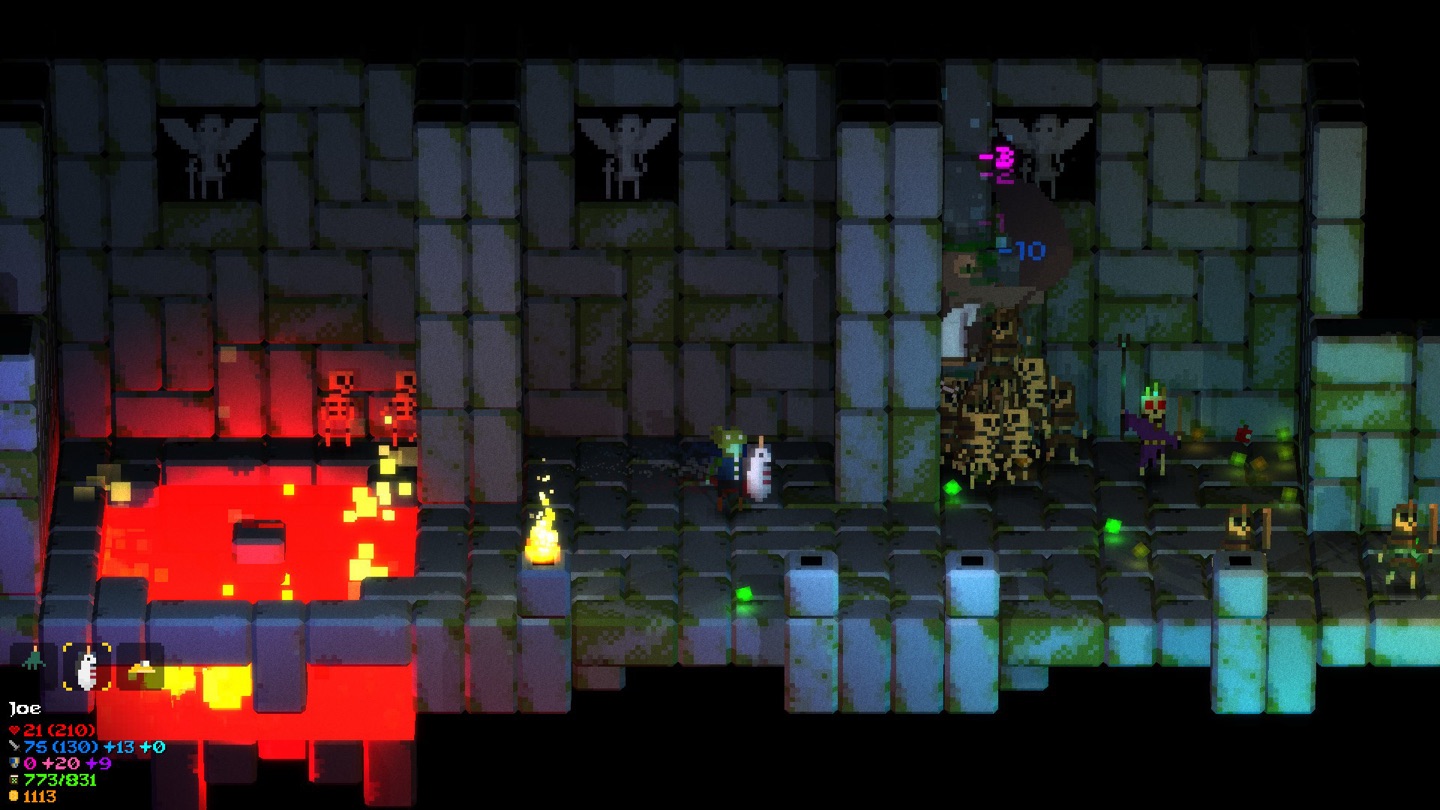
The visual style places chunky pixel characters inside a three-dimensional stone maze. The camera keeps the action side-on, while real-time lighting gives rooms a more spatial feel than a flat map. A lantern may cast a small pocket of light into blackness; a spell can fill a wall with color; lava and glowing enemies can turn a safe-looking route into a warning. The contrast between dark corridors and bright effects is central to the atmosphere, and your friends’ characters remain visible through their own screen positions and player displays.
The soundtrack is assembled dynamically from a large set of musical pieces, so the descent can move between uneasy tones and more energetic passages. Enemy sounds also signal danger, particularly when the room itself is hard to see. The mix of eerie stonework, bright pixel effects, strange hats, and absurd magical items keeps the dungeon from becoming uniformly grim. A suspicious creature may be a threat, but the equipment that helps you fight it might be a cat hat, a laser visor, or a weapon with a name that sounds like a joke.
The mood works best if you enjoy a dungeon that can be both threatening and silly. It is not a story-driven party RPG with dialogue scenes, role-play choices, or a long narrative between missions. The tavern gives the run a starting and return point; the treasure at the bottom supplies its destination. Most of the character comes from the rooms, enemies, gear, lighting, and music you happen to encounter, with the group’s own reactions filling in much of the social texture.
A small group with a big local footprint
Four players is the co-op maximum, and everybody shares the same computer rather than joining a native online lobby. Multiple controllers are supported, with fully configurable controls; the game also allows each player to set up their own input. That can be helpful for a group with different preferences, although the amount of inventory scrolling and the menu setup may feel less comfortable than a modern game with a simpler pickup-and-play layout. The display can pull back as characters move apart in a room, but the more space the group occupies, the smaller each pixel character becomes on screen.
Remote streaming depends on the host’s setup and internet connection.
Randomly generated rooms, enemies, items, and potion effects give the route plenty of variation between attempts. The local and online scoreboards offer a separate reason to collect treasure, and Steam achievements mark additional goals. Still, the core loop does not become a persistent online progression game: it is one descent-and-return challenge at a time. You can try a different class, find new gear, and see what the changing dungeon gives you, but the appeal rests on exploring another run rather than building a permanent shared base or a long co-op character campaign.
Who this dungeon fits
Legend of Dungeon suits a group that wants one shared screen, a compact set of controls, and an expedition where an unlucky run can turn into a rescue effort. It is less suitable for friends looking for native online co-op, clear explanations for every item, or a finely tuned combat system with lots of attack commands. The simple brawler core makes it easy to understand what your character is doing; the random effects and sparse guidance can make it less obvious why one item or encounter is better than another.
The four-player format can be lively around a single display, especially when everyone can see the same creature swarm or spell effect. It can also make rooms crowded, and an inventory that relies on scrolling is not instantly graceful when enemies are closing in. If your group enjoys high-variance dungeon runs and does not mind local setup, the ghost mechanic keeps a defeated friend part of the run while the others are still standing. If you need online matchmaking or a more forgiving way to pause a long expedition, the game’s core structure may be a poor fit.
For friends who can play together locally, the appeal is clear: choose your inputs, descend through a different maze, and see which weapons, hats, potions, and surprises the dungeon hands your group. You are all aiming for the same treasure, but each character’s equipment, health, and survival remain personal. The trek back to the tavern is what turns a successful descent into a completed run, and one teammate’s ghost can still help the party keep that goal alive.