Shipwrecked on an island run by technological cats, you and a friend are forced onto the theater stage to rescue Hatty Hattington. BattleBlock Theater turns that rescue into a two-player platforming campaign, playable online or on one computer. You cross trap-filled rooms, collect gems, and use each other to reach routes neither performer could manage alone. If more friends are around, Arena expands the group to four for short minigames and score challenges. The campaign is the main cooperative draw; Arena changes the pace rather than extending the story to four players.
Two performers, one escape route
Story mode is built for one or two players. The game’s bizarre framing device gives each level the feeling of another compulsory performance: curtains rise, a room full of blocks and hazards appears, and an energetic narrator keeps commenting as you try to get through it. The cats are guards and audience, Hatty is the friend you are trying to save, and the story treats this whole arrangement with the seriousness of a school play that has gone spectacularly wrong.
The goal inside a stage is easy to understand even when the route is not. Find enough green gems to open the exit, then get both performers there. Gems sit on the main route and in tempting side paths; yarn is usually harder to reach and counts toward your end-of-level grade. A doorway, switch or barrier may stop one player while the other looks for the mechanism that opens the way. Some routes branch, loop back or send you through a hazard sequence before you can regroup.
The campaign is not simply the same solo level with a second character added. The current Steam version has revised some hidden gems and puzzles to make its solo and co-op paths more distinct, and some sequences now require both players to pass through. That matters in rooms where one performer can stand on a switch or block while the other crosses a gap. You might also toss your friend to a ledge, pull them up, or use a head as an improvised step. These interactions give ordinary platforming a shared-problem feel: reaching the exit is the common goal, but a small timing mistake can put either of you right back into the room’s hazards.
Physics with a theatrical streak
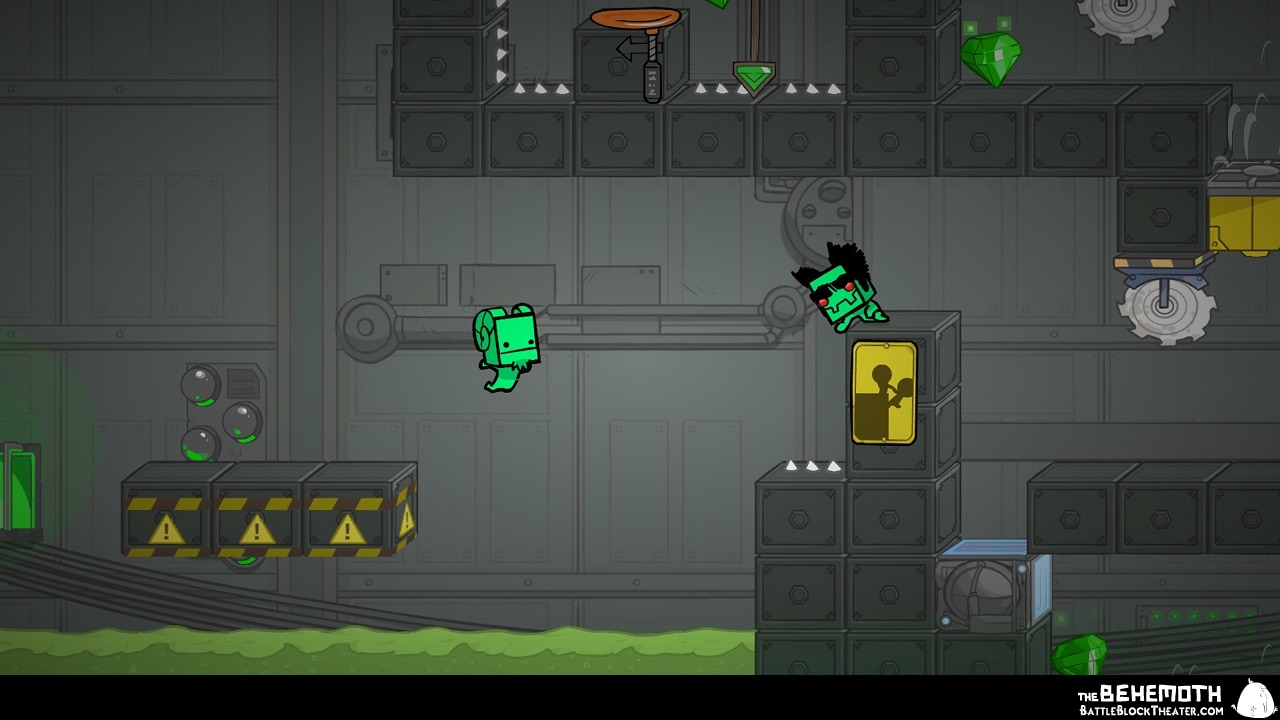
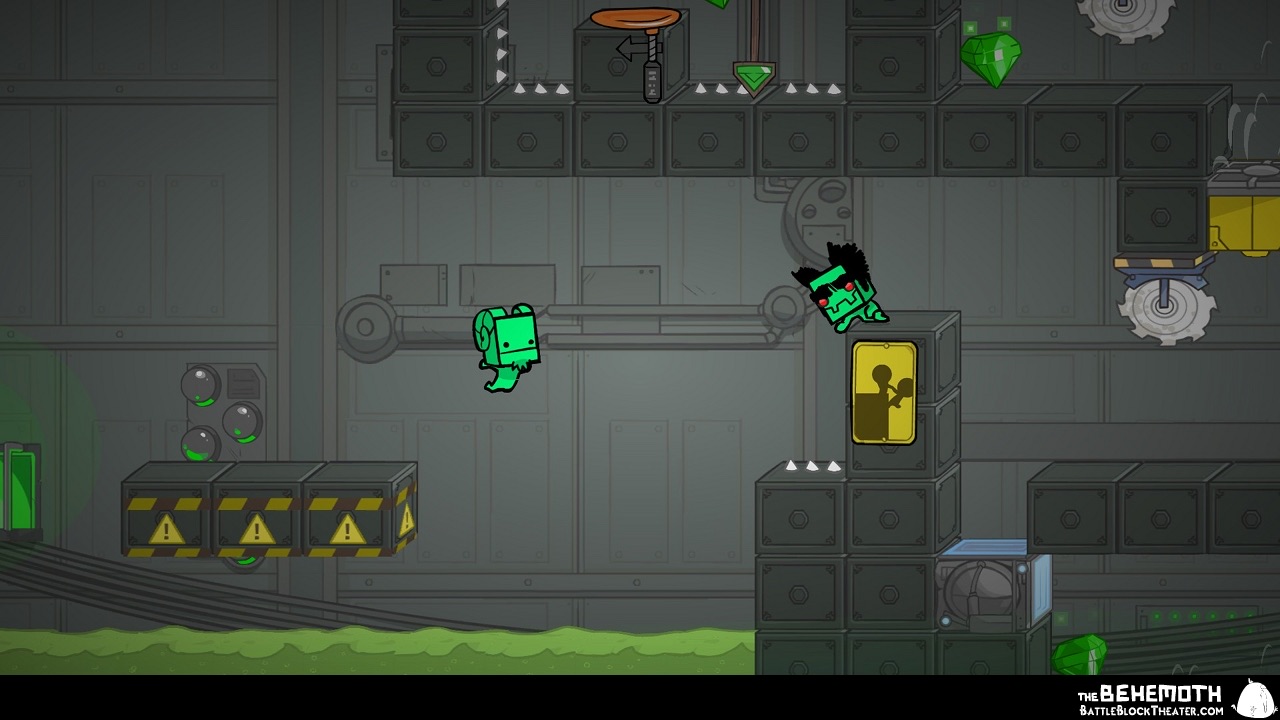
Your prisoner can run, jump, double-jump, wall-jump, slide, dash, push and grab. That gives you a compact set of moves to carry through a wide variety of stage machinery. A platform may fade when a laser strikes a switch elsewhere. A block can rise, fall, bounce or carry you across a gap. Ice changes how far a slide takes you, while water and spikes turn a slightly mistimed landing into a very visible pratfall. The game teaches new block behaviors in manageable pieces, then combines them into busier rooms where jumping and puzzle-solving happen at once.
The two-player camera keeps both performers in the same scrolling scene instead of giving each person a separate half of the screen. That makes it easy to see what your friend is attempting, but it can also make a fast, moving room feel hectic. One player can be on a lower route while the other is already heading toward a switch above; a moving platform or a monster may complicate the reunion. The shared view suits short stages and quick rescues, though the screen can become crowded when hazards, enemies and effects overlap.
Combat is part of that chaos, but it is not the most precise side of the game. You can punch, slide into, throw or otherwise shove characters, and the Gift Shop offers weapon-tools with distinct effects. A Frog Bomb, for example, creates an explosive hazard; an Acid Bubble can trap or hurt whoever crosses it. You can carry two tools and swap between them. Those weapons work against the cats and can affect performers too, so the same gadget that clears a path can interrupt your friend’s jump. BattleBlock Theater labels its story “co-optional” for a reason: the objective is shared, but its physics and attacks make accidental sabotage easy. The comedy often comes from a rescue attempt turning into a tumble for both players.
That looseness is a better fit for slapstick than for exact combat. The movement puzzles are the stronger side; hand-to-hand fights can feel imprecise or crowded, especially when later rooms fill the screen with enemies and explosions. If your group mainly wants a clean fighting system, Arena is not a substitute for a dedicated fighter. Story is strongest when you treat the weapons as one more source of stage trouble and focus on the platforming route they open or disrupt.
Gems, yarn and the grade at the curtain
A successful stage moves the campaign forward, but the pickups give you reasons to look beyond the exit. Gems help free prisoners through the Gift Shop, unlocking new heads and characters for your performer. Yarn can be traded for more weapon-tools. These are cosmetic and equipment rewards rather than separate character classes: prisoner heads change your look, while the weapons add options for pushing, stunning or damaging things in a room.
Each level also grades your run. The score reflects how many collectibles you found and how quickly you reached the end; an A++ run asks for more than simply grabbing the minimum gems and leaving. That turns a finished level into something you can revisit if you want the missing yarn, a cleaner time or a better score. The puzzle remains the same broad task, but the optional pickups can pull you into a side passage or make a safe route less safe. Gems are campaign currency that you can spend at the Gift Shop to free more prisoners.
The normal campaign is forgiving about failure. You can die in a trap, return at a nearby point and try again without restarting an entire chapter. That helps the game support experimentation: throw a friend across a gap, discover that the landing is worse than expected, and make another attempt. For players who want more pressure, Insane difficulty limits the run to one life per level. The difference changes the mood of a familiar room: a missed jump stops being a quick joke before a respawn and becomes a much costlier setback. It is an optional challenge, not the baseline expectation for a casual co-op session.
When the theater opens the Arena
Arena supports up to four players online or locally, while Story remains the two-person campaign. Its eight modes turn the same movement and weapon set toward shorter match objectives. Some focus on fighting or disrupting opponents; others make you chase a changing score target. In Muckle, the point is to outscore rivals through brawling. Soul Snatcher revolves around taking an opponent’s soul and trying to hold onto it. Ball Game asks players to move a ball into a goal, while Grab the Gold turns a flying whale’s dropped treasure into a race to the safe. King of the Hill and Color the World shift attention to holding or changing parts of the map. Capture the Horse and Challenge add a creature-retrieval contest and a timed course to the mix.
Those examples show why Arena is a useful change of pace rather than a four-player version of Story. The group can choose a round with a clear score condition, try a different mode, and switch again without committing to campaign progress. Some modes set players against one another or split them into teams; others make the course or target itself the challenge. With four friends in the same room, Arena is the option that fills all four seats. It also works online, while the main co-op story keeps its two-player cap.
The arena matches use the same hazards and weapon-tools that make Story unpredictable, but the goal changes. A platform can be a route one moment and a way to knock someone off balance the next; a weapon can buy a point or interrupt another player’s attempt to score. This helps the minigames feel connected to the campaign’s physics even when their objectives have little to do with rescuing Hatty. The tradeoff is that Arena is more dependent on how much your group enjoys quick, messy rounds. If your group prefers the puzzle campaign’s longer platforming challenges, the short competitive rounds may feel less engaging.
More stages if you want them
The level editor builds rooms from the game’s block palette, letting you arrange platforms, traps, switches, enemies and other interactive pieces. You can make a straightforward jump challenge or a more complicated contraption for friends to test. Steam supports sharing and playing community-made levels through Workshop features. That adds more ways to explore the mechanics after the official stages, though the quality and difficulty of user creations naturally vary.
The official stages already have reasons to revisit them: optional collectibles, improved grades, secret areas and alternate co-op puzzles. Some rooms and A++ time targets have been adjusted, while the package includes hundreds of levels across Story, Arena and other content. The campaign is best thought of as a long sequence of short stage plays rather than one uninterrupted platforming gauntlet.
Setting the group up
For local Story, one person can use the keyboard and another a supported controller; two players cannot share a single keyboard. If you want more than two people on one computer, Arena is the mode designed for four. The current Steam version includes broader controller support and Steam Input compatibility.
Online Story supports two players, and the current online sessions include join codes so friends can connect without first adding one another to a Steam friends list. Arena supports four online. Remote Play Together can stream local multiplayer to a friend, but the session still uses the local player setup and its input limits. The game offers online and local routes; it does not make a four-player campaign out of the two-person Story mode.
BattleBlock Theater works best for friends who want short, readable platforming rooms with a strange comedy show wrapped around them. You share the goal, but not always the cleanest route: one person can hold a switch, boost the other up, grab a side-path gem, or accidentally turn a jump into a pratfall. When two players have had enough of the campaign’s traps, Arena offers a separate place for up to four friends to chase points and interfere with each other. The split is straightforward: two players for the story, four for the party modes, and at least one controller for couch co-op beyond the keyboard player.