Divinity: Original Sin (Classic) lets you and one friend share its full fantasy campaign, from a murder investigation in Cyseal to a much stranger threat. You each play one of the two Source Hunters, explore an isometric world, and take part in turn-based battles and story decisions. The Classic version supports two-player co-op through online or IP-based LAN play, with drop-in and drop-out sessions. It is a long-form role-playing adventure where your friend is a second protagonist, not a guest who only joins combat.
You each shape one of the two heroes
The campaign begins with two Source Hunters arriving in the coastal town of Cyseal to investigate a councillor’s murder. Suspicion falls on forbidden Source magic, but the case opens into a larger threat to Rivellon. You make two protagonists before setting out. In solo play, one person manages both; in co-op, each player controls one. The game’s four-person adventuring party can also include up to two recruitable companions, who fill out the group without taking away your friend’s role as a lead character.
That split gives both players a voice in the adventure. When an NPC conversation involves your character, you can choose how to respond. Your friend may be somewhere else in town, talking to another character, searching a nearby room, or following a different clue. The world does not force the pair into one shared conversation camera or make one player wait for the other to finish every small interaction. You can regroup when it is time to compare discoveries or face a fight.
The freedom can also make co-op delightfully unpredictable. A character can slip away to investigate or pick a pocket while the other keeps a guard occupied. Both heroes can take part in conversations and move independently rather than automatically following each other. That means you can pursue separate activities in the same area, but it also means one player’s decisions can create a problem the other did not expect. Story choices persist in the host’s campaign, so a surprise fight or a conversation that goes badly becomes part of that shared playthrough unless the host reloads a save.
Disagreements are part of the dialogue system
The two protagonists are written as a pair who can agree or clash. Some conversations ask each hero to weigh in on a decision. If you both choose the same response, the party follows that outcome. If you disagree, the game resolves the argument with a rock-paper-scissors contest influenced by the characters’ personality. The winner’s preference carries through, and repeated choices can develop personality traits that affect later interactions.
This system makes even an ordinary dialogue prompt a cooperative decision rather than a vote controlled only by the host. You can support a guard, challenge them, or push for a different approach while your friend argues for another. Sometimes the result changes how an NPC sees the party; at other times, it can send you into combat. The game does not require you to make every choice together, though. You can split up and let each player handle separate conversations, which suits a pair who like comparing discoveries as well as a pair who want to talk through every major decision.
Turn-based fights reward elemental improvisation
Exploration happens in real time, but fights shift to a turn-based system built around action points. Each hero can move, attack, use an item, or cast a skill within the points available for their turn. Initiative affects turn order, and position matters: enemies can block a route, ranged attackers can punish an exposed character, and a spell aimed at the right surface can reshape the fight.
Divinity: Original Sin is especially interested in those surfaces. Rain can douse flames and leave water that conducts lightning. Oil can slow a group of enemies, then ignite when hit by fire. Ice can melt into water, while poison clouds and other effects can be redirected or made more dangerous. One player can make the ground hazardous while the other attacks from a different angle, or you can coordinate abilities to stun or funnel enemies. Battles are not simply a contest of damage numbers; the environment, the party’s abilities, and enemy status effects all interact.
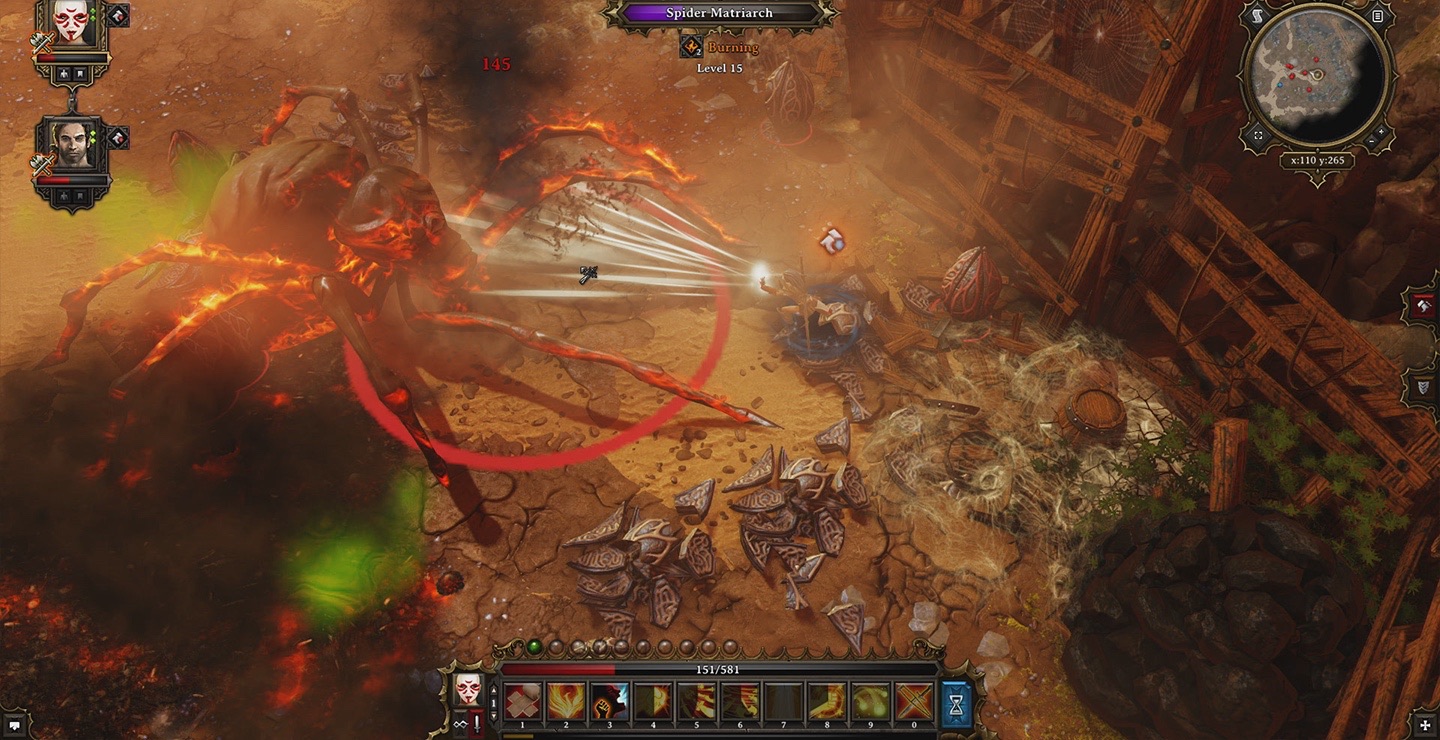
That freedom works in both directions. Fire and electricity can hurt your own party if you stand in the wrong place, and status effects such as freezing, poison, or burning can interrupt a plan. The game’s tougher encounters often expect you to use terrain and skills together. Some battles center on dangerous mages or status effects, while others make retreat and regrouping part of the encounter’s rhythm. The system leaves room for a clever plan, but its rules are not always explained at length in the moment.
Flexible characters, long-term party building
Character creation is classless. Preset builds can give you a starting point, but neither protagonist is locked into a permanent fighter, rogue, or mage role. You develop attributes, learn skills, and equip weapons and armor as you progress. The available skill schools let characters blend abilities: one hero might handle ranged attacks and scouting while another mixes melee combat with healing or elemental magic. The game still rewards a party with different strengths, because some obstacles and enemies ask for a specific answer.
Recruitable companions add extra characters to the group, and each main hero can bring one along. You can adjust their skills and equipment as they level, then divide control of them between players. In co-op, your friend continues to own one Source Hunter while the remaining party members can be assigned where useful. That lets two people manage a varied group rather than reducing the game to only two active characters.
Equipment, crafting, bartering, exploration, and character skills all feed into this progression. You can combine ingredients and items, look for merchants, learn new abilities, and use the world’s objects to solve problems or create new ones. Many doors and encounters allow more than one approach. A locked entrance may invite a key, a lockpick, a spell, or force. You can move objects, search rooms, and test skills outside combat. Those systems make a new area feel like a collection of possibilities, while also giving the party plenty to inspect and manage between battles.
A campaign that asks you to look around
Cyseal is not a short prologue that immediately sends you along a marked route. Its mystery unfolds through conversations, clues, side quests, and exploration. Quest markers and journal entries can leave you to connect details yourself, and the game is happy to let you wander into areas or encounters that are currently beyond your strength. Enemies do not scale neatly to the party, so some encounters can feel overwhelming when a region’s challenges outpace the party’s current strength.
This open-ended structure gives you and your friend room to disagree about where to go next. You can inspect a suspicious building while your partner talks to a witness, or try a solution that turns a peaceful conversation into an unexpected battle. The choices can change who is friendly, which tasks remain available, and what the party learns. There is not always a single obvious path through a quest, and some clues are easy to miss if you only follow the journal.
The broader adventure continues through multiple regions, with new enemies, puzzles, characters, and equipment to discover. You will move between town life and dangerous wilderness, find hidden rooms, solve environmental puzzles, and face bosses with their own tricks. A long campaign gives the pair time to develop distinct builds and a shared memory of the decisions that brought you there. It also asks for patience: this is not a mission-based co-op game that wraps up in a few evenings.
What to know about playing together
Classic supports two-player co-op. Sessions allow drop-in and drop-out through Steamworks, or IP-based connections for LAN and internet play. You can start a multiplayer lobby, invite a friend into a single-player campaign already in progress, or join theirs, even if one of you is farther along in the story. The connection menu controls who may join: Nobody blocks new players; Everybody allows anyone; Friends Only admits Steam friends; Invitation Only admits invitees. Each player controls one of the two main heroes with mouse-and-keyboard controls.
Enhanced Edition is a separate release from the Classic version covered here.
A better fit for a patient duo
This co-op works best as a shared campaign for two people who want to explore, talk through consequences, and let each other act independently between battles. You get two leading characters, companions to round out the party, and a world where conversations, elemental effects, and everyday objects can all affect what happens next. A friend joining online or over LAN participates in the story, not just the fights.
The trade-off is an old-school adventure that can be opaque and demanding. Its journal may not spell out every next step, combat can punish an underleveled party, and character management asks you to learn a lot of interlocking systems. This co-op suits two players who want to share a long fantasy campaign, explore at their own pace, and take part in turn-based battles as separate protagonists. It is a long-form adventure rather than a series of short matches.