BOMBANANA! asks three people to defuse one bomb while each person is missing a different piece of the picture. One player can handle the device but cannot see it. Another can read the manual but cannot speak. The third can see the bomb and teammates but cannot hear them. Together, the trio has to turn separate clues into the right actions before the timer reaches zero. It is a communication puzzle dressed up as a loud, slapstick monkey party—and it only works when the group can keep talking, watching, and listening.
Three roles, one shared problem
The Blind Monkey is the hands-on operator. They can inspect and interact with the bomb, but cannot see its modules or read their labels. The other roles have the visual information the operator lacks: colors, symbols, positions, and sequences that can be translated into actions at the device.
The Mute Monkey has the rulebook and cannot speak. That player reads the instructions and uses gestures and emotes to communicate with the others. Gestures and emotes carry the information that spoken instructions would normally provide, alongside the manual’s rules. This role is a deliberate communication constraint, not a silent spectator seat. The Mute Monkey’s gestures and manual knowledge are necessary inputs to each puzzle.
The Deaf Monkey can see the bomb and the other players but cannot hear them. That makes this player the visual link between the operator and the rulebook reader: they can observe what the bomb shows, watch the gestures, and relay useful details. The role can become a relay race. One person spots the relevant clue, another knows what the manual says, and the operator has to make the input. If a message changes meaning as it crosses the team, the clock keeps moving. The trio can choose roles or leave assignments to chance, giving the group a direct way to shape the round’s information relay.
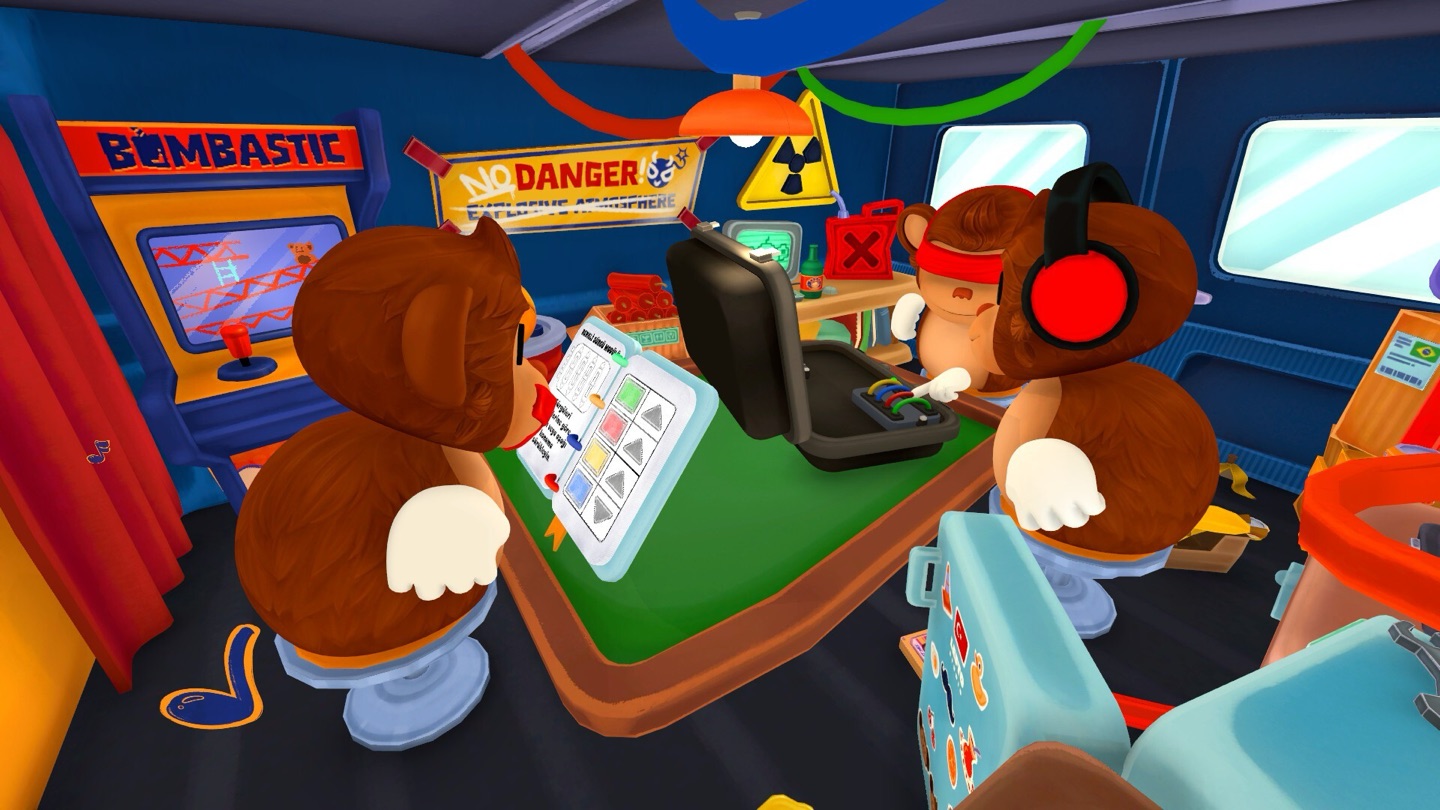
Communication is the main mechanic
The central challenge is not simply solving a set of logic puzzles; it is solving them through three mismatched points of view. The Blind, Mute, and Deaf roles each have different information limits, so a complete solution depends on the team connecting what each person can perceive. A module’s state, the matching rule, and the action at the bomb all have to meet before the timer runs out.
Two roles need a microphone; the Mute Monkey does not. The game also gives players gestures and emotes, along with physical interactions such as slapping. Those flourishes give the group extra ways to react, celebrate, or make a chaotic moment funnier. They do not remove the need to coordinate. The constraints give each person a reason to stay involved, and make quick voice-and-gesture exchanges central to the puzzle. Groups looking for a quiet or low-communication session may find that core loop a frustrating fit.
Learn the modules together
Each bomb combines modules with their own rules. The player at the device can see the puzzle and operate its controls, while the player with the manual can look up what a signal or pattern means. The remaining player helps move information between those views. In the cable module pictured below, connected-cable count and active-light color identify the wire to cut. The Deaf Monkey can report those visible clues, the Mute Monkey checks the manual and signals the choice, and the Blind Monkey makes the cut by touch. A wrong relay can cost one of the allowed mistakes, depending on Custom settings.
The campaign broadens this relay beyond wires. Early levels add color sliders and direction controls; a later calculator can require a second lookup after its first answer. Other puzzles use piano keys and switches, and some bombs combine several module types. On a direction panel, the Blind Monkey can read a tactile Braille number, the Deaf Monkey reports the active light, and the Mute Monkey checks the matching direction in the manual. The game also offers a color-blind mode that adapts colors in objects and the interface for two types of color-vision deficiency.
The system turns shared vocabulary into part of the puzzle. A symbol, color, or position has to be described in a way the other roles can recognize, and an incorrect action can cost a mistake or the run, depending on the settings. The rules are learned through play, so early attempts can involve figuring out how the bomb and manual describe the same module. The presentation keeps that learning process playful, but the timer means confusion has consequences.
The role split gives the trio distinct kinds of work: tactile interaction at the bomb, reading and gestures, and visual observation and relay. Those differences are visible in the puzzle itself rather than hidden behind a conventional menu of classes. The humor comes from the situation and the monkey antics; the cooperation comes from the fact that each role holds information the others lack.
Campaign, Endless, and Custom
The Campaign has 30 handcrafted levels that grow more difficult. Defusing bombs unlocks further levels, giving a group a set of authored challenges to work through together. That structure gives you a place to learn the core loop before deciding whether you want a more open-ended session. Certain puzzle variants can change while their underlying structure and solution method stay consistent, so learning each rule is more useful than memorizing one exact layout. That makes the authored campaign a place to practice adapting the same communication roles across new combinations before trying Endless or adjusting a Custom run.
Endless mode switches to procedurally generated, wave-based challenges that increase in difficulty. Instead of moving through the same authored campaign sequence, your team tries to keep handling new waves as the pressure builds. This is the straightforward option when the group wants to see how long it can stay in sync. Its escalating format also means that a good run depends on whether the three roles are communicating cleanly, not only whether one player has memorized a puzzle.
Custom mode lets the group change the ingredients of a bomb-defusal run. You can adjust bomb difficulty, timer, module types, environmental hazards, and the number of mistakes allowed. The range runs from less punishing practice settings to more pressure through tighter limits or extra hazards. These settings do not change the basic structure. You still need three players sharing information across the same role constraints.
The bomb does not wait politely
Interruptions such as power cuts, blocked views, and loud disruptions appear alongside environments including a minivan and an airplane. These complications reinforce the central problem: the trio already works with restricted information, and the scene can make it harder to see, hear, or act on a clue. A distraction can be funny when everyone recovers together, or costly when it obscures an important detail. One interruption brings a radio into play; a teammate can throw an object at it to stop the malfunction before the bomb timer runs out.
Role restrictions and interruptions layer on top of each other. The Mute Monkey’s gestures, the operator’s controls, and the Deaf Monkey’s view of the scene all matter while the countdown continues. When a message gets lost, time slips away and the operator risks a wrong input before the countdown ends. The pace stays brisk without turning every module into the same kind of problem.
The game’s sense of humor comes from putting a serious little task inside an absurd scene: monkeys, a bomb, gestures, interruptions, and an instruction manual that only one teammate can consult. Those elements can make a failed attempt feel like a shared gag. Still, the puzzle loop asks for attention; it is not a background party game where everyone can drift in and out while the timer runs. The voice and gesture channels are part of the rules, so a player who cannot use the group’s chosen communication channel may have a hard time contributing, especially while the trio is learning the module language.
Is your trio a good fit?
BOMBANANA! suits a regular trio that enjoys conversation-led co-op and slapstick mishaps. Online play requires exactly three players; two roles need a microphone, while the Mute Monkey does not speak. You can join by room code or through the server browser without adding one another as Steam friends. Windows and macOS versions and controller support are available. The timer and active voice-and-gesture relay make it a poor fit for two-player nights or quiet, low-communication sessions.
Campaign levels receive performance grades, giving your group a concrete reason to revisit a favorite and improve its result. A failed attempt can also reveal where the information relay broke: perhaps someone misidentified a module, misunderstood a gesture, or matched a rule to the wrong control.