Path of Exile lets you take an online party of up to six players through a dark fantasy action RPG built around monsters, equipment, and character builds. You and your friends fight the same creatures and bosses, explore connected zones, and gather loot while your characters grow in different directions. A normal party is for fighting the game’s monsters, while PvP is a distinct competitive activity. The game includes recruitable mercenaries, but they do not count as party members.
The online requirement shapes the whole experience. You need a working connection and the game’s service to enter its world; it is not a shared-screen game for one computer. You can invite friends into a party and enter the same instance, with party members able to join a friend’s area through a portal.
A shared journey through a dangerous world
Your route begins in Wraeclast, a harsh continent where exile is punishment and survival depends on what you can find or defeat. The campaign sends you through settlements, wilderness, ruins, and enemy-held interiors. Most areas mix movement with short, intense encounters: creatures stream toward you, ranged foes attack from across the screen, and a stronger enemy can turn an otherwise routine fight into a sudden retreat. Quests provide reasons to cross zones and confront bosses, while equipment drops give you a steady stream of decisions about what to keep, sell, or use.
Playing together changes the feel of these encounters without turning Path of Exile into a role-locked team game. Your characters share a space and attack the same enemies, but each friend brings an individual build, pace, and set of skills. Enemies become more demanding as additional party members join, and splitting up can mean one character misses experience or parts of the action. The game’s sprawling zones invite exploration, but the best co-op moments come from having the party in the same fight rather than scattering across the map.
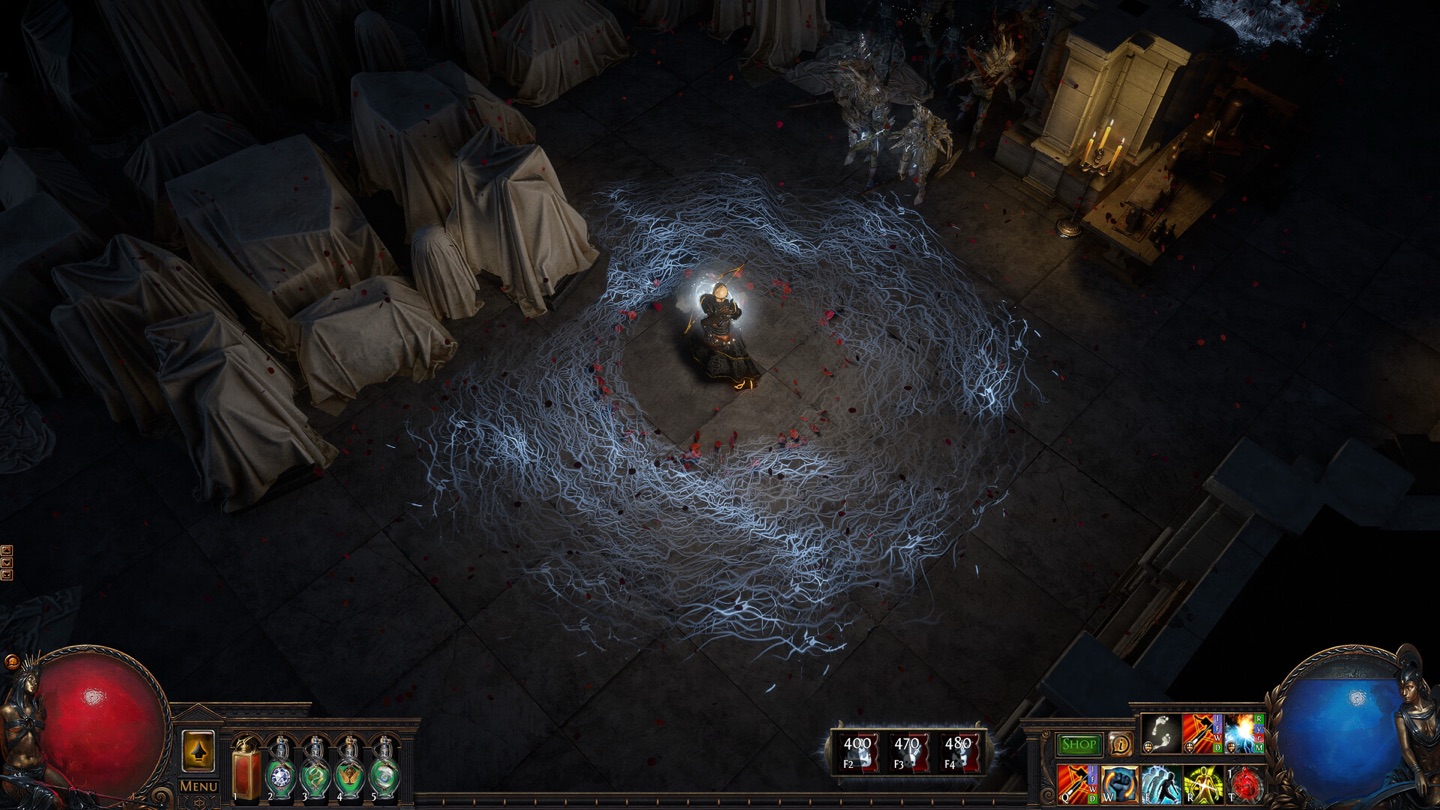
The overhead camera keeps the ground and incoming threats in view, while the visual language draws on ruined settlements, caverns, forests, and occult architecture. A route through an area can move from a quick cluster of ordinary enemies to a room that forces the party to watch for heavier attacks and changing hazards. Bosses make those shifts more pronounced, with larger health pools and patterns that reward movement and timing. Each encounter remains part of the same action loop, but the combination of monster abilities and terrain gives a zone more texture than a line of identical fights. Bright spell effects stand out against a subdued world, but several characters using attacks at once can make a fight visually busy. This is a game where the screen can fill with overlapping projectiles, elemental flashes, auras, minions, and enemy effects. Players who enjoy dense action may find that exhilarating; players who prefer every attack to remain easy to parse may find some moments hard to read.
The story is told through characters, quests, environmental clues, and the consequences of moving through a world that treats the exiles as disposable. It gives the campaign a dark fantasy mood, but the action and build systems stay at the center. You are not expected to manage a long chain of dialogue choices or coordinate a tactical command phase between rooms. Your party keeps moving, fighting, improving equipment, and learning how the next area behaves.
Seven starting points, countless builds
You choose one of seven character classes, each starting in a different part of the shared passive skill tree. These are starting positions rather than sealed roles. The tree stretches across the same enormous map for every class, so a character’s direction comes from which bonuses and connections you pursue. A class may suggest a broad style, but it does not lock you into a familiar tank, healer, or damage-dealer slot. Two friends who choose the same class can still build very different characters.
Active abilities come from Skill Gems that you socket into your equipment. Support Gems can alter or extend the skills they are linked to, changing how an attack behaves or what it does to enemies. That system is the reason a character’s abilities are not defined only by class selection: your gear sockets, gem choices, passive points, and equipment all contribute. You might focus on a projectile skill, summon creatures to fight alongside you, spread damage over an area, or build around spells and elemental effects. There is room to experiment, but the number of interacting choices can be a lot to learn if your group wants to jump straight into deep optimization.
Equipment shapes this flexibility as much as the passive tree. Weapons and armor carry sockets, and the number and links between sockets affect which gems can be used together. Upgrading an item can therefore mean more than comparing its defense or damage: a replacement may change the support gems available to a favorite skill. Currency items also serve as crafting materials, so the loot you find can be useful even when its base equipment is not an immediate upgrade. The result is a steady cycle of trying skills, finding gear, and revising the character that uses them.
That flexibility has a social side. One player can specialize in effects that help nearby allies, another can focus on clearing packs quickly, and a third can make a durable character that stays in close combat. These are possibilities the build system permits, not fixed jobs that every party must fill. You do not need a prescribed class composition to enter the campaign. A flexible game with years of expansions will also rarely have a single answer to questions such as “Which build should we play together?” A character can start from a broad theme, then change direction as its gear and skills develop.
Character growth comes through levels, passive points, quests, and new equipment. In the campaign, each area introduces different monsters and stronger challenges, while bosses put the focus on learning attack patterns and surviving several phases of danger. Better gear can improve defenses, damage, and the resources you need to use skills. Gems can level and sometimes change how their skill works. That steady stream of upgrades supports a long campaign, but it also means a character can feel weak or awkward if its gear and skills stop working well together.
Friends may reach an area at different levels or earn account progress differently. Party members can still fight through the same monsters and bosses, while individual quests, map completion, and other account milestones may advance differently.
From campaign zones to the Atlas
After the campaign, the Atlas of Worlds gives you a broad endgame built around maps. A map opens a separate area with its own layout, enemies, rewards, and modifiers. Changing those modifiers can make an outing more dangerous and potentially more rewarding, so familiar territory can still produce a different run. Maps can alter enemy defenses, add hazards, or change the rewards, making the same general activity feel different from one area to the next. You can also run into league content layered onto ordinary zones, which adds encounters and objectives beyond simply reaching the exit. As your characters gain strength, map tiers and tougher encounters offer a long ladder to climb. New expansions and challenge leagues add systems that can change what you encounter and what you chase, so the endgame is not one fixed sequence that your group finishes once and leaves behind.
The Atlas is a major reason groups return for many sessions, but map progress can be less symmetrical than the campaign suggests. Completion may center on the character whose map is opened, while party members share the encounter; the same run can therefore leave Atlas progress uneven.
Leagues provide separate rule sets and progression cycles. Standard and Hardcore variants offer different stakes, while Solo Self-Found is designed around playing without party or trading support. League membership shapes who can party together. League mechanics can add their own encounters or rewards, but the familiar loop stays recognizable: enter an area, defeat its inhabitants, collect upgrades, and develop your character.
The trade-offs of a shared build journey
Path of Exile gives your group a large space to learn together, but it asks for more attention than a straightforward dungeon crawl. You can spend time comparing gems, sockets, and passive choices between fights. The skill tree invites long-term experimentation, though its size can make character planning complex and the next useful upgrade unclear. The game rewards curiosity while asking you to make decisions that interact across many systems.
Loot is another point where a party’s expectations matter. Enemies can drop equipment and currency as you fight, and an item that interests one player may be useful to someone else. Depending on allocation settings and league rules, ownership of a valuable drop can become a point of friction. The loot chase is rewarding, yet sharing its rewards may take more discussion than dividing a chest evenly.
Effects and enemy groups make battles energetic, and a coordinated party can tear through a crowded zone. The same visual density can obscure what is happening when many skills overlap, especially in a packed encounter.
Path of Exile suits friends who want online monster-fighting, open-ended character building, and an endgame that can keep changing. It asks you to accept a learning curve, dense effects, and occasional differences in individual progression. PvP exists separately for players who want competition; it is not what a normal party campaign turns into. It is a strong fit for a group that wants to connect online and shape its own builds over many sessions.