In Left 4 Dead 2, you and your friends cross a city, swamp, or carnival in a first-person shooter while an infected horde closes around you. The standard Campaign supports up to four survivors online, with computer-controlled teammates filling any open survivor spots. A full voice call can have one player for each survivor; a smaller group still has the other survivors moving with it. You can keep an online session private for your invited friends. Your destination is a safe room, an escape vehicle, or another chapter in a route through the Deep South. The way between those points keeps the group connected: ammunition runs low, a friend can be caught by a special infected, and a quiet stretch can end in a rush of bodies.
Online Campaign is the simplest way to play with friends. You can also host a LAN-only Campaign, though setting one up requires console configuration. The regular PC menu has no split-screen Campaign; sharing one computer needs extra controllers and setup, and whether Remote Play Together works with that arrangement is unclear. Check before planning couch play.
The four survivors bring different personalities to the trip, and their exchanges continue as the group travels. Coach is a former football coach, Nick is a sharply dressed gambler, Ellis is an eager mechanic, and Rochelle is a reporter. Their dialogue gives the campaign a human scale between attacks; all four can pick up the same weapons and supplies.
Every campaign moves toward an escape
Each Campaign tells a story across connected chapters, with a safe room marking the end of most sections. Your group leaves one shelter, crosses the infected area, and reaches the next door with whatever supplies and injuries it has accumulated. The route eventually builds to a finale: sometimes a rescue arrives after a holdout, while another chapter asks the survivors to reach transport or cross dangerous ground to get out.
Chapters give your group different kinds of work along the way. Some ask you to reach a point through streets and buildings; others involve getting an alarm going, finding fuel, or surviving an attack until a mechanism or escape route is ready. An objective can put you in the open for a while, with ordinary infected gathering around and the sound of a horde making it hard to hear what is happening farther down the street. A safe room gives the group a short pause, then the next chapter continues the escape.
The finales make those routes end in different ways. In Dead Center, the crew gathers gas cans in a mall atrium to fuel a getaway car while infected fill the floors around them. The Parish ends with a dangerous crossing over a bridge toward evacuation. One asks your team to keep moving between scattered supplies; the other turns a wide stretch of road into the last part of the escape. Both endings grow from the chapters that lead to them.
The changing locations give that trip a strong shape. The route ranges from Savannah’s hotel and city streets to Hard Rain’s wet roads and heavy downpour. Swamp Fever sends the crew among flooded paths, wooden buildings, and trees. It also brings Mudmen, common infected coated in muck who crawl through the waterlogged paths. Dark Carnival swaps those shadows for midway lights, rides, and clown infected. The Parish moves into New Orleans streets, where the skyline, bridges, and evacuation route bring the trip to its final escape.
The Director shifts pressure and pathways
The AI Director watches how the team is doing and shifts the timing and amount of enemy pressure. It can send a horde through a stretch that felt quiet on an earlier trip, hold back while you cross a building, or bring special infected into a fight when the group is already occupied. Director 2.0 can also vary pathways and parts of the level layout, along with enemy populations, weather, lighting, effects, sounds, and world objects. Weapons and supplies can appear in different places. Campaigns still follow authored chapters and recognizable objectives, but a familiar section need not have the same route on another run. Difficulty settings change the overall challenge; the Director shapes pacing and local variation as the team moves.
The infected that arrive are more than different targets. A Smoker’s tongue can pull someone away from the group; a Hunter can pin a survivor to the ground; a Jockey can steer a victim off course. A Charger barrels into the team, while a Spitter’s acid turns a patch of ground into a temporary hazard. When one of those attacks separates a friend, another player can free them by dealing with the infected. That interruption changes what the rest of the group faces in the same fight.
Other threats affect the whole crowd in a different way. A Boomer’s bile draws common infected toward survivors it hits, and a startled Witch can punish nearby disturbance with a sudden, heavy attack. Those pressures can overlap with a horde already moving through the area, so an attack on one player can change what the whole team faces.
Supplies make every teammate part of the same fight
Firearms give you range and sustained fire, while the game’s large melee selection brings the fight up close. Shotguns scatter damage into nearby crowds; rifles let you keep shooting from farther away. Pistols provide a backup, and a second pistol or a melee weapon changes that off-hand slot into a different kind of close-range option. The katana, axe, frying pan, and chainsaw bring different close-range attacks. When infected press in, a melee swing changes the pace of the exchange from firing another magazine.
Your loadout has limits. You carry one primary weapon and one secondary, plus a throwable and a major support item such as a first-aid kit, defibrillator, or ammunition upgrade. A first-aid kit and defibrillator use the same slot, so each survivor chooses one. Pills or adrenaline take another small-item slot. Gas cans and similar mission objects occupy your hands while carried, so the person holding one is not firing a weapon at that moment. Those boundaries make ammunition, healing and objective items part of the group’s shared situation; each survivor has only so much room to bring into the next chapter.
Throwables also have different effects on a horde. A pipe bomb draws infected toward it before exploding, a Molotov leaves an area burning, and a bile bomb marks a target that attracts the crowd. Incendiary and explosive ammunition upgrades add another option. These are brief tools within the larger firearm-and-melee setup: they change the immediate field, while the survivors keep the same compact equipment slots through the campaign. With four players, each person’s pickup becomes a visible part of what the group has available during the next attack.
That becomes important when somebody is hurt or incapacitated. A teammate can pick a survivor up from the ground, or use a first-aid kit on them instead of saving it for their own health. A downed survivor can still fire a sidearm but can only crawl, while reviving them occupies another teammate as the infected remain active. Pills and adrenaline offer temporary help; adrenaline also speeds up actions such as healing and reviving. A defibrillator can return a dead survivor on the spot. In standard Campaign, a dead teammate may also reappear in a rescue closet farther along the chapter, where the others can open the door and bring them back. The group can recover from a loss, but a missing player still changes its immediate firepower and attention.
The setting keeps the escape tense and grotesque
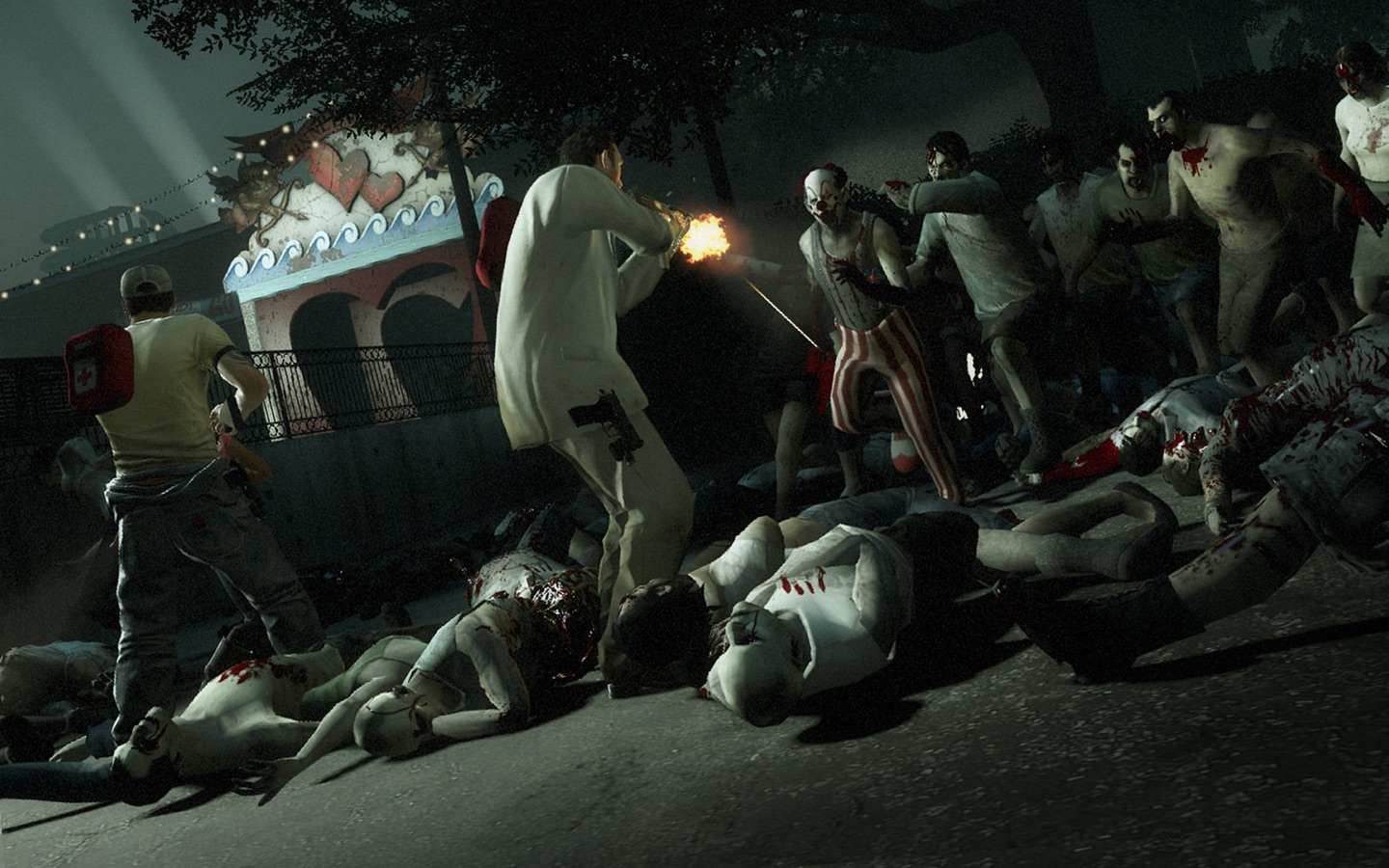
Left 4 Dead 2 frames its action as horror, with wet streets, dim interiors, infected voices and the distant noises of a horde. The survivors answer one another with short bits of dialogue as they move, giving the journey some character while the environment fills with danger. Hard Rain’s downpour reduces visibility and turns the roads into flooded passages. Swamp Fever uses dark water and narrow wooden walkways. Dark Carnival’s midway is bright and colorful, but the infected clown’s squeaky shoes can announce another threat in the middle of all that spectacle.
The violence is graphic. Infected fall apart under gunfire and melee hits, and the game’s blood and dismemberment are part of its presentation. It is closer to an action-horror escape than a quiet suspense story, and its character banter keeps that danger from becoming solemn all the time. A campaign can move from a shadowed stretch of road to a lit attraction, then push the four survivors back into a desperate final crossing.
More than one way to spend a session
Campaign is the central cooperative mode, and the same four-player online group can also try Survival, which places survivors in one location against continuing waves and tracks how long they last. Realism changes Campaign’s rules: survivor and item outlines disappear, common infected are tougher, and rescue closets are disabled. A dead teammate must wait for a defibrillator or the next chapter to return, making death a more lasting loss within a level.
Survival trades Campaign’s chapter-to-chapter escape for a single location and an endurance clock. Both use the same four-survivor frame, but one session follows a route to a finale while the other measures how long the group can hold out.
Versus changes who controls the infected. Up to eight players online split into two teams of four, play the same chapters from opposite sides, then switch roles. One team guides the survivors through the chapter while the other controls special infected and tries to disrupt their progress.
Scavenge also supports two online teams of four, with short rounds built around fuel cans. Survivors deliver cans to keep a generator running and extend the timer while the infected team disrupts them; the sides then switch. Mutations are official rule variations on existing modes, and their player counts depend on the selected variant.
Familiar campaigns, community-made routes
The Steam Workshop adds community-made maps and add-ons, including player-created Mutations. Valve’s official Last Stand update began as a community project and added a Lighthouse campaign based on a Survival map, plus new Survival and Scavenge arenas. That gives your group more ways to return to the same four-survivor setup, from a full campaign route to shorter mode-specific sessions.