Starbound turns a space-survival adventure into a shared online sandbox for up to four players by default. You and your friends can follow its story, descend into dangerous missions, or set the campaign aside to build homes and wander between strange planets. Everyone travels with a separate character, inventory, and starship, while the host provides the universe you visit together. That mix makes Starbound a flexible co-op game, though its open-ended structure can leave friends progressing at different speeds. It is online play across separate computers; the game does not offer a shared-screen session.
A damaged ship opens a big map
The opening gives your group an immediate reason to leave the ship: you have fled a catastrophe, your vessel is damaged, and the nearby planet holds what you need to get moving again. You beam down, collect materials, craft tools, and explore caves and settlements. The ship becomes the starting point for a much longer cycle of landing, gathering, upgrading equipment, and lifting off toward another world.
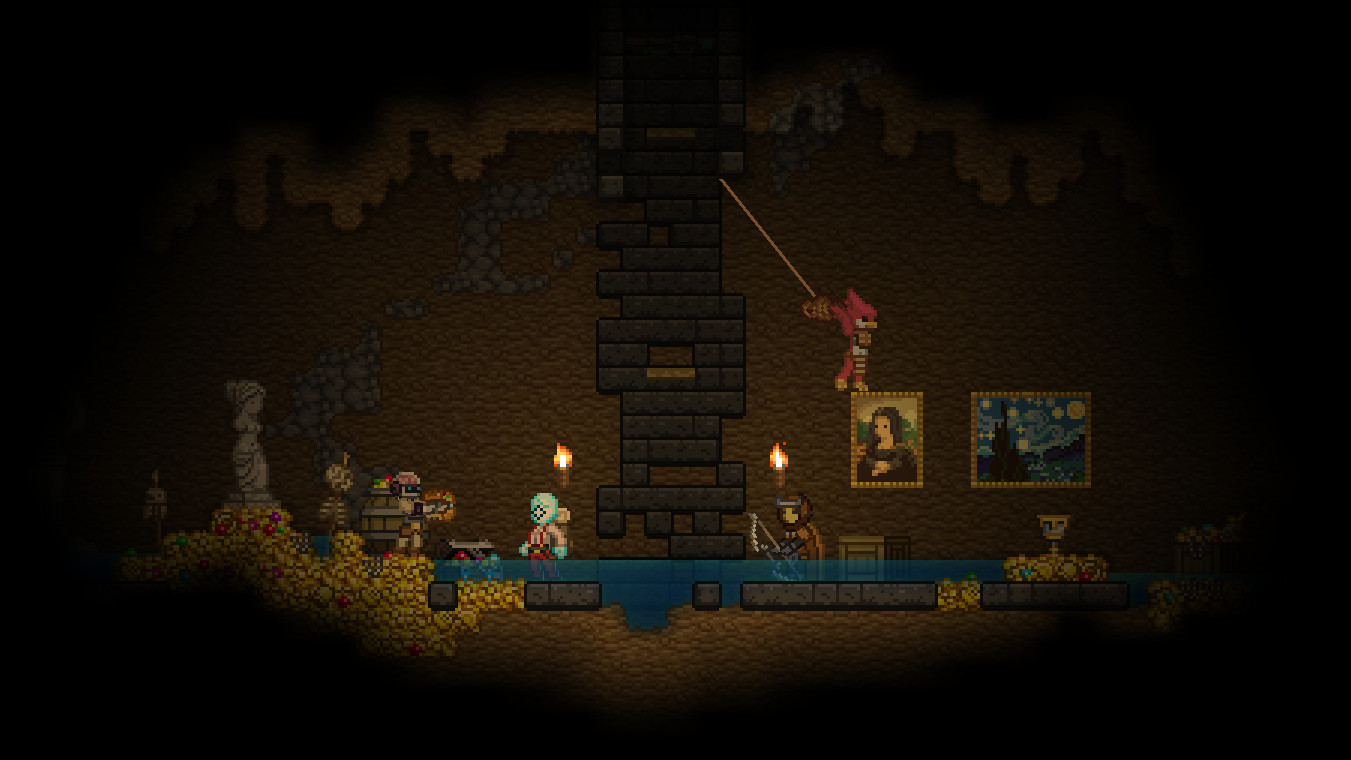
Planets are generated with different terrain, weather, creatures, and buried places to investigate. One descent may lead through a calm forest while another sends you into a dark cavern or across an ocean floor. You dig horizontally and vertically through a side-on landscape, which lets you choose whether to follow the surface toward a settlement or tunnel after ore and hidden rooms. Dungeons and ruins interrupt the resource hunt with traps, enemies, and treasure. New materials let you improve armor, weapons, tools, and crafting stations, opening routes to environments that would be dangerous earlier in the journey.
The variation is the main fuel for exploration, but it is not a promise that every planet will surprise you. Some surface areas repeat familiar shapes and creatures, and the ongoing loop can become more about mining the next material than discovering a new idea. For a group that likes making its own detours, that repetition leaves room to turn a short resource run into a cave expedition or an unplanned visit to a settlement. Friends looking for a tightly directed string of missions may find the planetary travel less focused.
One host’s universe, several characters
A regular friend session can start by joining a player’s game through Steam. The game also offers dedicated server software for a world that stays available while its host is away, though a self-hosted server takes more configuration than a friend invite. The host’s save supplies the planets and world state. Friends who join bring their own characters, carried items, and ships, so they are visitors in a shared universe rather than copies of the host’s character.
Once you form a party, you can use the party interface to locate friends and beam to a party member’s ship. Players do not have to remain on the same planet at every moment: one person can work on a base while another mines below ground or scouts a nearby settlement. That flexibility gives everyone room for their own projects, then makes it possible to regroup when a dungeon, boss, or new planet is worth exploring together. It also means co-op does not always feel like a synchronized expedition; your friends can be active in different parts of the same world.
Over a long-running save, the host’s universe and character quest progress may drift apart. A later visit could bring the group back to a changed planet while some characters remain earlier in their quests. This is a possible wrinkle, not a guaranteed outcome, and it may matter most when friends play on different schedules. Groups happy to build and explore between missions may be comfortable with that looseness; those wanting a shared story pace may find it harder to keep everyone aligned. You can still regroup around a story mission when you want a common objective.
A group can fight together, but the sandbox does not assign fixed combat roles. Weapons include close-range blades and ranged firearms, while armor and crafted upgrades set how prepared an explorer is for tougher worlds. That flexibility keeps character builds open, but it also means the game will not hand you a ready-made tank-and-healer lineup. Combat interrupts digging often enough that a trip underground can alternate between mining, dodging, and clearing creatures before you return to the vein you were following.
A story campaign with optional detours
The main story connects exploration to a sequence of quests and self-contained missions. Your ship’s onboard system guides you toward objectives, including a chain of race-themed dungeons with their own enemies and bosses. These missions are separate from the wider planetary map and can be launched from the ship; they have checkpoints, and most reset when players leave. Completing the story’s major missions unlocks artifacts that lead toward the final confrontation. Friends can join an online session in progress and leave when they need to, so you don’t need a separate co-op campaign.
The story gives you somewhere to go when you want a clear objective: reach a new location, search its rooms, and fight through the boss encounter at the end. The sandbox around it stays available when your group wants something looser. You can return to a planet to finish building, take on errands from residents, gather a material for a new tool, or leave the next mission for another session. That change of pace is one reason a single shared world can support both planned quests and longer stretches of improvised play.
Your character’s survival mode affects the pressure on those trips. Casual removes the need to eat. Survival adds hunger and, outside instanced missions, can drop some carried materials and consumables when you die; those items may be recoverable, while 30% of carried Pixels are lost. That makes planning gear and supplies matter on a cave run. Hardcore combines Survival’s hunger with permanent character loss, making its consequences more severe. These are character modes rather than fixed party roles: Starbound does not ask one player to select a healer or another to lock into a tank class. You outfit your explorer with crafted or found weapons and armor, then decide whether a shared outing is about combat, resources, or whatever the planet happens to reveal.
Build the home between missions
Starbound’s construction systems give the group a second kind of progress. Blocks and furniture can turn a shelter into a home, a workshop into a production space, or a rough settlement into a decorated colony. You can farm crops, keep animals, and recruit some friendly residents as tenants. Their quests and gifts add small goals around a base, while a completed structure gives the shared planet a recognizable landmark. The game tracks this kind of work alongside the main campaign without forcing every session to advance the story.
Your ship is another project, but it is personal to your character. You can decorate its rooms and expand it as you recruit crew. Crew members stay aboard and some provide travel bonuses; a small group can follow their owner to planets and help in combat. They are companions, not replacements for additional human players, and each friend still brings a separate ship into the game. On a shared planet, one person might build a colony while another returns to a ship to sort supplies or change equipment.
There is no formal class system dividing chores between players. The game’s seven playable races mainly shape the character you create, while equipment, weapons, captured creatures, and the choices you make on a planet shape your moment-to-moment approach. Some sessions can center on clearing a mission together; others can drift among farming, building, hunting, scanning creatures, and gathering ingredients. The shared world makes those activities coexist without requiring everyone to stand in the same room.
The group limit and hosting choice
Expect a default party of four players total, including the host. Raising that limit is a manual configuration change rather than the normal co-op setup, so four is the useful number when deciding whether the base game fits your group.
Online is the supported way to play together. Online play requires broadband internet. The simplest way to join a friend is to invite them through Steam into a game already in progress. A separate dedicated server can keep running after the host closes the regular game, but running one yourself may involve network and firewall settings. Port forwarding applies to that manual server setup, not to an ordinary Steam friend invite. Starbound is not couch co-op: each player needs a separate computer.
For a group of two to four friends, the practical appeal is the variety of ways to spend time in one universe. You can push through story missions, gather supplies for a shared base, decorate separate ships, or split up to explore and regroup later. The limits are just as clear: the default party stops at four, local shared-screen play is absent, and friends with different schedules may find the host-centered world harder to keep in sync. Starbound suits groups who want a broad planetary sandbox that can absorb both a quest and a building project, more than players seeking a tightly paced co-op campaign with a fixed sequence of levels.